
Big Giving Has a Class Problem
Joan Williams: The Working Class’s “Middle Finger” Is for Us, Too.

People want to live in a society where hard work yields a stable life. Yet today, only 30 percent of Americans believe that if you work hard, you can get ahead. This number has been falling for decades, and Big Giving has felt little urgency to address it.
But how did this happen, and what is there to do about it? On Break Fake Rules, Joan C. Williams and I talked about how liberal establishment politics lost the working class–essentially by abandoning them, and what it would take to turn the tide.
Income inequality is up, economic mobility is down, and fewer people than ever believe that succeeding within our current system is even possible. Joan mentioned that Americans born in 1940 were virtually guaranteed to earn more income than their parents, with 93 percent earning more. For people born in the 1980s, that number is down to 50 percent.
On the 2024 electoral map, the counties where people were suffering the most economically went dark red. People living in places that our leaders and Big Giving continue to neglect are understandably angry. This shocked many in 2016 and certainly has not changed. As Joan put it, “Hillary Clinton was proud that she won the counties that represent two-thirds of the economy. But the counties that represent the other third are not well pleased, and they’re voting with their middle finger.”
In March, I asked on this blog, “Can Philanthropy Save Democracy?” Today, I’m tempted to wonder if this is even the right question.
When we talk about saving democracy, we are both assuming people know what we mean and think there’s something alive in our current system that’s actually worth saving.
According to a new report from Democracy Revival Center and FrameWorks Institute, only 4 percent of Americans say the political system is working extremely or very well. Nearly three-quarters (72 percent) think the system is rigged against them. This is true for a majority of people across parties, races, and income levels. And in general, people don’t really know what we want to defend when we say we want to defend democracy. Researchers note that, as a concept, many people think democracy is synonymous with “what the U.S. does.” So, in fact, our key message is alienating. Because why are we attempting to protect the system that’s failing them? This doesn’t mean that we shouldn’t save democracy. But it does mean we need to focus on why it matters and how it ties into people’s everyday experiences.
In all aspects of their lives, middle- and working-class people get daily evidence showing how the deck is stacked against them by elites. Whether that’s in the form of elected officials’ broken promises, rigged tax policies, or multibillion-dollar endowments that are invested in 95 percent counter-mission hedge funds and stock equities while their communities suffer.
I have been stunned that Big Giving has spent little time discussing this devastating report from Rand, which says that since 1975, inflation, corporate depression of wages, and tax policy (including tax shelters like foundations and DAFs) have generated the largest transfer of wealth in history. Eighty trillion dollars has moved from the working class to the 1 percent. I have not seen one article, conference panel, or convening produced by Big Giving in the past five years that has focused on this highly destabilizing reality. Yet, Big Giving has convened multiple times over the past year alone to ensure that our assets (and our tax breaks) are protected from government interference. Could it be that, as beneficiaries (and generators) of this historic transfer of wealth, we aren’t able and willing to address it?
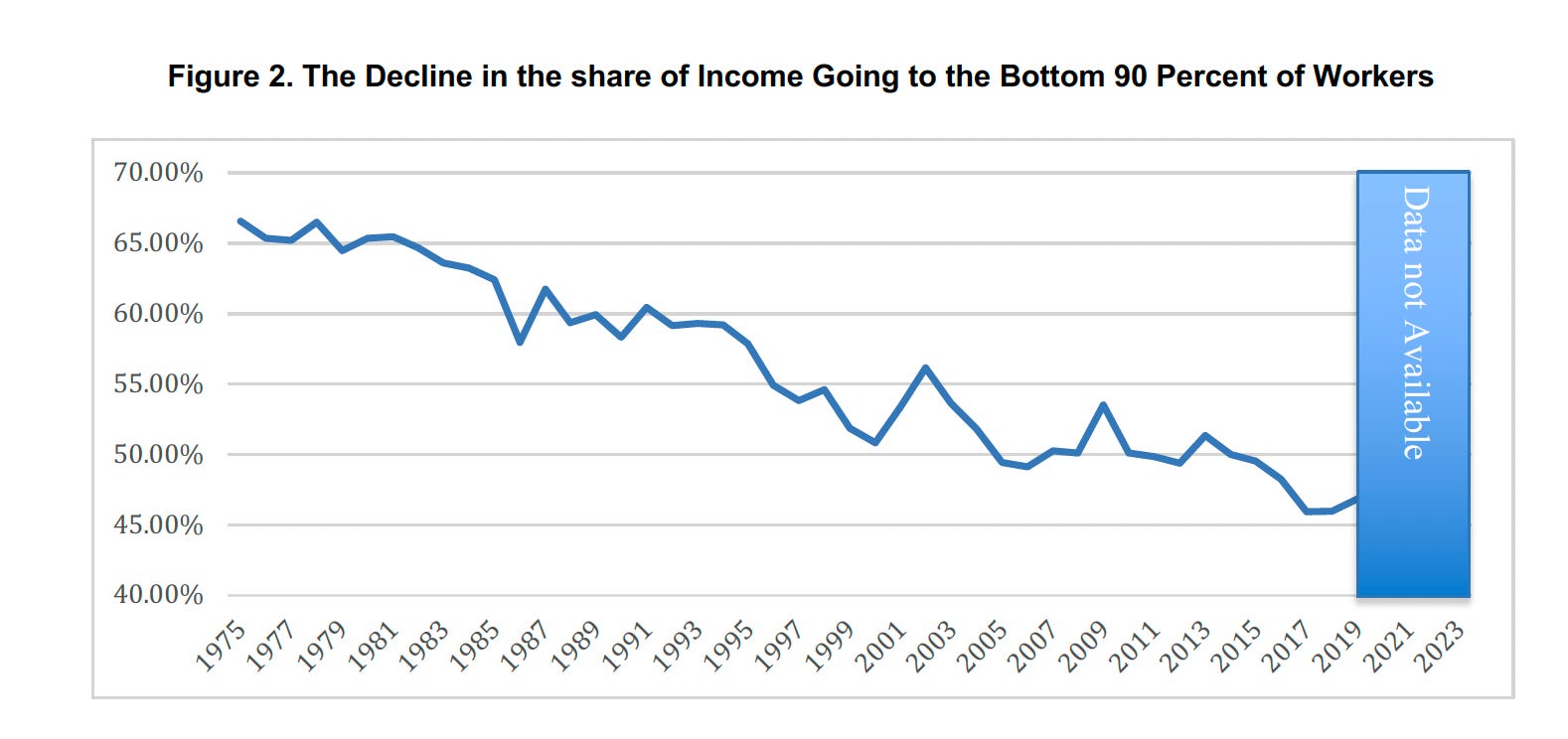
In addition to seeing where the money flows, working-class people can also see exactly what elites typically think of them. In her book Outclassed. How the Left Lost the Working Class and How to Win Them Back Joan talks about class condescension. Liberal elites scorn people who didn’t attend college, even as the promise of “college for all” fails to pan out. And many of us who work in leadership for the sector prioritize issues in a way that speaks to an educated professional class while ignoring the economy. Failing to center economic justice in our work has directly contributed to lost political ground and democratic backsliding in recent years.
Joan and I talked about how progressives and our philanthropy are too often framed around a very specific worldview that much more closely represents the top 20 percent of high-income households than it does the middle 50 percent. This causes Big Giving to perpetuate the same unequal structures that led to our gigantic amassing of wealth in the first place. Institutional philanthropy gives, as Bess Rothenberg of the Ford Foundation put it in Nonprofit Quarterly, to “organizations with access and power who can navigate complex grants, and leaders from backgrounds of elite privilege that mirror their own.” In my book, CONTROL, I write about how when funders are centered, communities can’t be. Sometimes funding a portfolio that fully reflects what our communities are calling for means taking ourselves and our biases out of the decision-making equation.
As we work to shift giving away from donor control and toward community engagement, we need to be funding things that will bring some truth back to the promise that working-class Americans shouldn’t have to struggle and all people here deserve to live a good life. Joan offered some specific, concrete ideas for policy approaches that can begin to win back the working class: Make vocational training and apprenticeships free and widely available. Rebuild union power and honor blue-collar jobs and workers. And invest in small businesses as an economic onramp.
As the economic fallout from the Iran war continues to worsen, middle America is going to be hit hard. A recent study showed that as of February this year, the average American was just a little over $6,000 away from financial ruin. Bankruptcy filings were already up 11 percent in 2025 and will likely continue to worsen as the cost of living skyrockets. Gas pump prices don’t matter to the rich, or to those who can’t afford a car. But for the middle 50 percent, they matter enormously. Philanthropy can stem the damage by disbursing funds faster and in larger amounts, and by investing in tools such as vocational infrastructure, union power, and small-business support that help the middle 50 gain economic ground.
In how we address the next phase of this crisis, we have an opportunity to do things differently, and maybe even to start winning back those who’ve long since felt left behind.
—G.
This is why I'm spending my days building our #StableLiving™ model at Pathway Communities. Will be looking into your book and Stupiski Foundation as our foundational model incorporates 1) attainable housing (ownership) 2) digital equity 3) financial literacy 4) food sovereignty and 5) social ecosystem (support and wellness) These aren't negotiable - they're must haves in our model.
Great read. Musing - might there be an inherent conflict of interest for charitable organisations (Big Giving) to strive for and push for economic equality and reform? The very nature of people having ‘excess’ - the money beyond necessity (at any lifestyle level) to give to charity, fund benevolent organisations, and help others - places the donors in the economic elite. Those who makeup and fund Big Giving inherently have what they have because of the current system. The very reforms that would make the poor and salaried classes well-off, would simultanesouly make them worse off. Where one function of government is purely redistributive, whether directly via transfer or indirectly via service provision (e.g., free education), would the rich really vote for their own taxes to go up significantly?