
We Don’t Need More Critics. We Need Critical Leaders.
Here Are the Leaders I’d Award. Who Would You Name?

You may have heard from my first post of this year that I was named Inside Philanthropy’s “Critic of the Year.”
It was an unexpected honor. In a sector where the surest path to accolades has often been to protect foundation assets, to be named Critic of the Year feels both refreshing and a bit ironic. Perhaps it’s a signal that our collective appetite for the status quo is waning, and a hunger for honest reflection is growing. For that shift, and for the platform this recognition provides, I am thankful.
But let’s talk about the word “critic.”
If this recognition is for encouraging our sector to be more reflective, thoughtful, and willing to question practices that inadvertently cause harm and stifle impact, then I am honored. If “critic” means someone who asks “Is this what communities truly need?” while governments threaten healthcare and food security, then I’ll accept the mantle.
Yet, I can’t help but feel the term is a bit off for me.

Critics ≠ Critical Leaders
A movie critic isn’t tasked with reforming cinema; a book critic isn’t building a better library. Their work is important, but it is primarily observational and evaluative. What I am trying to do—and what we at Stupski Foundation and in solidarity with so many others are aiming for—is something much more active and involved.
We are not merely pointing at the stage; we are trying to rebuild it from the ground up with a different blueprint to serve a different audience. We are aiming to shift power from donors to communities, question stockpiling 95% of our annual assets in harmful hedge funds and speculation, and reimagine a system that too often mistakes privilege for wisdom. Instead of a critique from the sidelines, I see our work as critical to leadership from within our sector.
But this is where a painful contradiction of our sector comes into focus—we have perfected the art of celebrating “leaders” for expertly maintaining the status quo.
We’re awash with awards for the type of leadership that puts statements over substance and confuses well-produced videos with impactful giving, that celebrate a minimal 1% increase in annual giving during a deadly crisis as bold, and leadership that holds endless collaborative strategy sessions about the devastation communities are enduring—all while the investments that fuel our endowments actively undermine the missions we profess.
I see our sector providing praise for foundation leaders who reinforce the logic that the less we do, the more strategic we are. I’ve seen single foundations celebrated for raising tens of millions from each other for a pooled fund while holding back using their own $10 billion endowment so it stays invested in companies actively undermining said cause—to be used for a future crisis. Huh?
Too often, we don’t connect these dots, and that is a failure of leadership with real-world harm.
All this to say: I see the contradictions in our sector, but I am not aspiring to be a critic. I aim to be part of actively building a different kind of system, accountable mindsets, and servant models of leadership for philanthropy.
And I want to see the awards go to those who cause the right kind of trouble.
Who Gives?! Critical Leader Awards
If I had the honor of bestowing a Philanthropic Leader of the Year award, it would go to the architects of a more courageous, humble, and responsive practice.
My list includes leaders like Jamie Allison, CEO of the Walter & Elise Haas Fund; Dr. Carmen Rojas, CEO of Marguerite Casey Foundation; Ralph Lewin, exeuctive director of the Peter E. Haas Jr. Family Fund; Nwamaka Agbo, CEO of Kataly Foundation; Crystal Hayling, former executive director at the Libra Foundation; Ray Colmenar, president of the Akonadi Foundation; Brenda Solórzano, CEO of the California Endowment; and Dennis Quirin, former executive director of the Raikes Foundation—among others.
Why these folks?
Their work embodies the critical leadership philanthropy desperately needs. Over the years, I’ve seen these leaders demonstrate what’s possible when one dives into the hard, honest work of reflection—staring in the mirror, as I have heard Ibram X. Kendi urge, and asking challenging questions about power, privilege, and the essential role of our work.
I’ve seen these courageous leaders call our sector to account, pointing out that when billions are being cut from our social fabric, a 1% or even 5% increase in giving doesn’t measure up. I’ve seen them practice a leadership that requires upending our sector’s obsession with institutional expansion in service of the communities we claim to serve.
The leaders I look up to move money with urgency, trusting communities on the ground. Many saw the crisis of COVID and swiftly increased giving to meet the moment, proving that our sector can move with speed and scale when we choose to. They highlight the stark contrast with the far-right funding machine, which for decades has been giving at scale without the restrictive suspicion many progressive funders exhibit, building power rather than just managing assets.
These leaders have built personal and organizational relationships that keep them accountable to vulnerable communities who are working to create a better future. They are willing to make changes and take risks, even if that means causing friction, because that is what meaningful change requires.
Thanks again to Inside Philanthropy for the “critic” honor. It has given me this chance to clarify our purpose. My hope, however, is that this year we are all celebrating a different model—one that stops praising tightfistedness and starts celebrating people and organizations that move money and power at the scale needed right now.
I’ll be over here celebrating the folks above and all those who model how to give more, risk more, and trust more than is comfortable.
Who would you name as a critical leader in philanthropy?
—G.
You Made CONTROL an Amazon Category Bestseller!
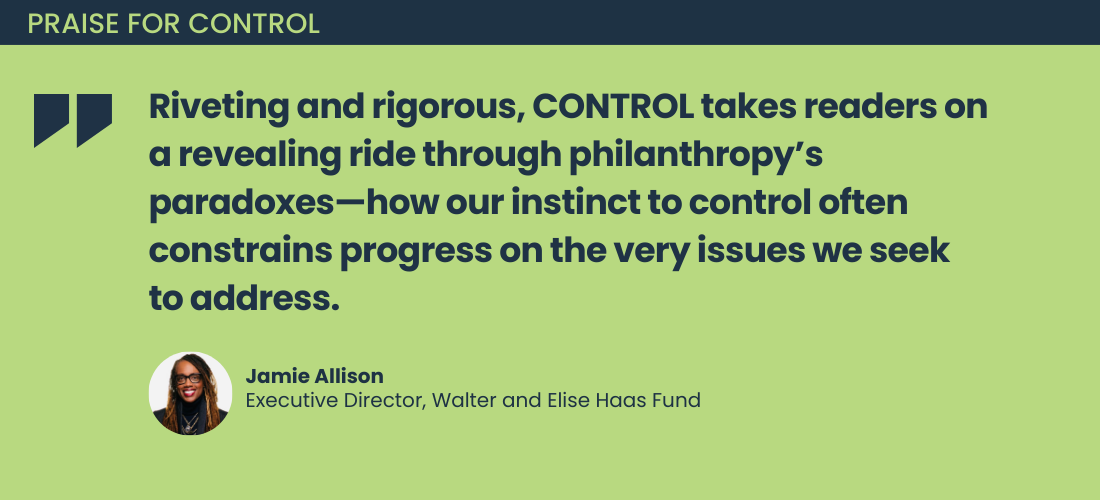
A heartfelt thank you to everyone who preordered a copy of my new book, CONTROL: Why Big Giving Falls Short, to be released by Wiley this March. Your early orders helped make CONTROL an Amazon category bestseller and #1 Hot New Release! If you haven’t preordered yet, it’s not too late. All royalties paid to the Stupski Foundation from the sales of CONTROL will go directly to the communities and causes the Stupski Foundation supports.
Let’s change the system of Big Giving for good. Take the CONTROL quiz to assess your mindset of control.
More on SubStack
Must-read pick of the week: Scot Nakagawa, author of The Anti-Authoritarian Playbook’s “Why You Can’t Understand American Authoritarianism Without Understanding Race, Or: How the War on Black Freedom Became the Infrastructure for War on All of Us.”
Michael Gast, author of Organize the Rich, has put together a helpful resource developed by folks on the ground about “How To Support Minnesota in This Emergency.”
You may already be familiar with Timothy Snyder’s key lessons from On Tyranny, but as the great John Lithgow says in this reading, “It’s time you heard them again.” The start of 2026 is as good a time as any to recommit to putting these lessons into practice.
Terrific piece, and also refreshing to see you receive the public recognition you deserve for your voice in this space (even if you redirect it to other equally important critical leaders.)